TTRPGs Need Instructional Designers
Introduction
This post is part review of my time reading The Rulebook and part recognizing the importance of Instructional Design for TTRPGs.
I've taken my time reading The Rulebook since it was a project last Fall among a group of bloggers (1). It does a great breakdown of rules into four categories: formal, internal, social, and material. There is a small chapter on external regulation that I will revisit later. The book is well referenced and thorough in discussing rules from a wide variety of games. In between bouts of theory, there are excellent one-liners that were eye opening for me as a designer. The first one I highlighted was this:
“Although formal rules aspire toward exact precision, they are not written in formal language” (Montola, Stenros, 2024, p. 22).
As I read the book, I annotated it, noting ideas I agree and disagree with. I do not mark-up books I own, so this was unexpected for me. However, I discovered this annotative process was my own form of Book Play. I created a set of Internal Rules of what color tab to designate for a given thought alongside how much of the text I was willing to highlight. I believe players often create internal rules unconsciously. It’s only when players are queried about why they played the way they did does it reveal their internal rules.
Designers Note: This is something designers could zero in on through playtesting.
What The Rulebook is Missing
I find it easy to take moments in a game and silo them into one of the four buckets of rules. While this is useful in understanding types of rules and their structure, what’s missing for me are a few things; the interplay of the categories, the complex learning required to form them, and the level of working memory players have (2).
Complex Learning is implied and referential, to some degree, in the Rulebook through its reliance on Constructivism, a learning theory that supports Complex Learning. Constructivism posits that learners build their knowledge through active experiences and interactions. It also relies on the Zone of Proximal Development (ZPD) which is defined as the following:
“[T]he distance between the actual developmental level (of the learner) as determined by independent problem solving and the level of potential development as determined through problem solving under adult guidance, or in collaboration with more capable peers” (Vygotsky, 1978, p. 86).
ZPD and Constructivism is how we get ideas for scaffolding and chunking appearing in many educational programs. This fits naturally with games, especially TTRPGs. ZPD is collaborative and social. In a tabletop setting, this would be like when a game referee brings a new system to the table and is teaching it to players. The ZPD is in the social exchange as players start to learn the formal rules of a game from someone who has a better grasp of the rules. Our example can be expanded to include PCs creating characters which utilize constructionist learning. The Rulebook dances around these concepts after introducing Constructivism, holding onto a singular learning theory without accounting for other factors at play. If we go one step further into pedagogy – and we should, we can arrive at the 4C-ID (Four-Component Instructional Design) model which wraps around Complex Learning in a comprehensive way or as the authors state, “a holistic approach”.
A couple of the main drawbacks, highlighted in 4C-ID, to Complex Learning have been Fragmentation and Transfer Paradox. The first is an idea of examining each component of learning individually and pushing for mastery in a singular area, while the second highlights how isolated, specific objectives don’t equate to a high transfer of learning. As noted by van Merriënboer & Kirschner, the authors of 4C-ID, Complex Learning by itself works well, “if there are few interactions between those elements, but often fails when the elements are closely interrelated because here the whole is much more than the sum of its separate parts” (van Merriënboer & Kirschner, 2007, p. 245). TTRPG systems would undoubtedly fall into this category, and designers should study the 4C-ID model when writing their rules of play.
The Rulebook must frame itself from a Constructivist point of view to analyze in depth how each type of rule behaves but at the cost of examining the interplay between them. For example, as a player, I might create an internal rule based off a broken social rule from earlier in play. The internal rule was created in reaction to the social rule. A different example could be where a formal rule is stricken due to a social rule overriding it. There are many more examples where the rules overlay in ways to produce new rules in the listed categories where they hinge on each other in various ways.
The 4C-ID model is much more representative to TTRPGs than Constructivism and could be argued to have been a better starting point for discussing rules.
Cognitive Load and Working Memory
The Cognitive Load Theory (CLT) has been discussed in the TTRPG space to help creators consider ways to parse, chunk, and deliver content in a frictionless manner to players. It states there are three types of cognitive load and the relationship between those load types and different types of memory (sensory, working, long-term). When reading about CLT, it can feel like an obvious concept but how should it be done is the harder question to answer. The Rulebook has zero mentions of cognitive load, which I find surprising. I wanted another chapter in the book called Internal Regulation that touched on these foundational ideas such as cognitive load, drive to play, level of engagement, etc. which can be assessed from player’s ability to process and interpret rules, especially since the External Regulation chapter has touchstones of parental control and laws. I also expected the chapter on external regulation to be a touchstone on some of the boundaries, caveats, and considerations of rules regarding CLT. There is an assumption made in The Rulebook about a player that disregards the importance of instructional design in relation to rules and play.
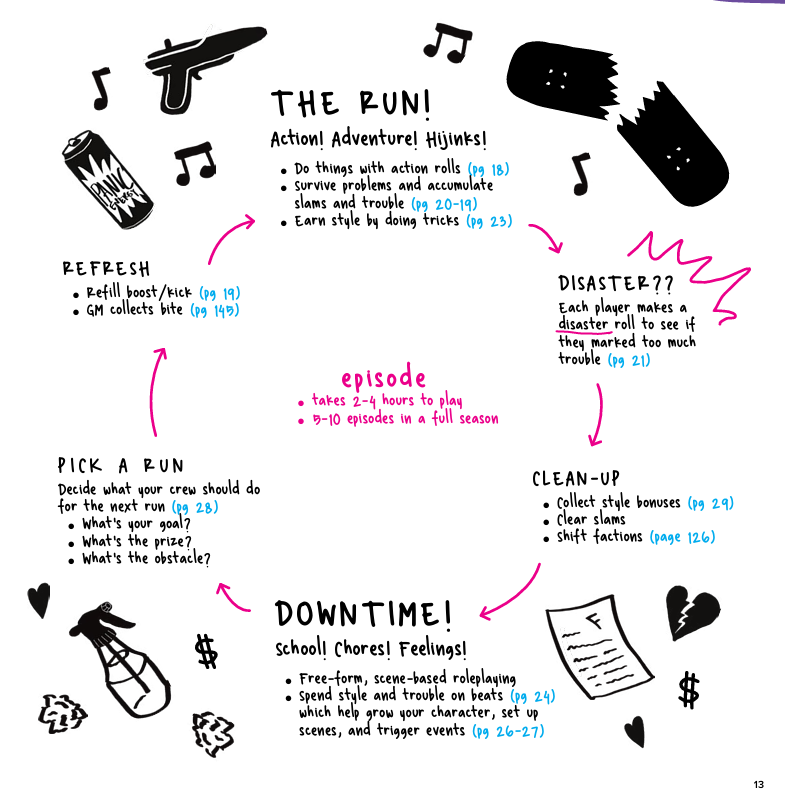
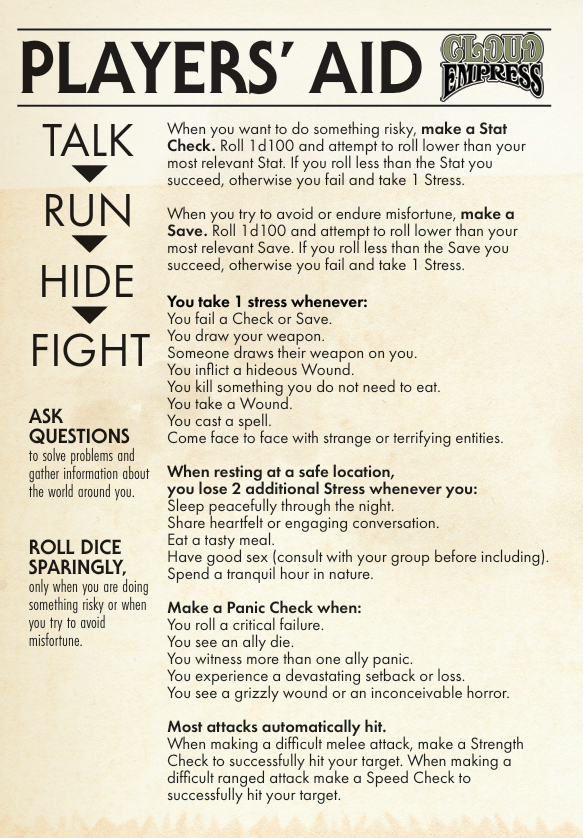
Some examples for TTRPG considerations to offset CLT would be providing a Quickstart with pre-generated characters and a starter adventure for onboarding players. Clear visual design of the gameplay loop of what a single session looks like. A glossary for repeated mechanics as a reference sheet. Chapters in a book naturally do this to break up large ideas and systems, and this is foundational for TTRPG creators. The importance of layout and visual design cannot be overstated. While a cool theme and enjoyable reading experience is nice, designers must consider the Book Play of their system. To this extent, I want to focus on one of the key components of CLT, Working Memory.
Working Memory is a concept that has been embedded in psychology, education, and neuroscience for a long time. It’s a system our brain uses to allow us to execute cognitive tasks with a chunk of information. I like to think of it as human RAM. We use working memory every day, but we give the system a run for its money when it comes to learning a new game. Remember, Working Memory is accessing a subset of our memories which means knowledge of rules are first deposited in Working Memory before taking up permanent residence in Long-Term Memory (e.g. A 20 on a d20 is a critical hit in 5e). Think of it as the time you’d use to flip to a rulebook to check something but eventually you know the rule word for word almost. Another great example of this would be mapping in a dungeon.
Knowing this is how our brains work, we can be mindful designers when writing our formal rules. Here is where layout and visual design can truly shine to ease the burden of player Working Memory. I have already listed a few examples of this, but as designers, we need to expand our understanding of how much information a GM and players can process. In this way it’s critical to consider Book Play for TTRPGs. Book Play here is the marking, bookmarking, hacking, etc. that comes with a GM and/or players engaging with the source material. To their detriment, most systems are not designed to be used in this manner. Rather, some systems expect players to internalize the rules quickly, while others don’t expect players to access some components until they’re in a later phase of the game. Yet players want to plan and when they’re engaged, they’re proactive in asking questions and digging through a book to find an exact answer to do the cool thing. While a table of contents and an index are natural solutions, surely there is something better we can devise. I’m a fan of the gameplay loop images in games like Slugblaster as well as player aids in Cloud Empress. I think there's more to excavate in this space, though. Solo TTRPG games are required to think about CLT as it’s the primary way the player engages with the world and mechanics. By default, they’re forced to share mechanics as necessary to ensure players can play them at all.
At the end of the day, I want to see more systems, adventures, and settings thinking a bit more like instructional designers or at least including instructional designers in the conversation. One common goal of creating and sharing these rulesets and imagined stories is to teach them to other people. Ideally, instructional designers will be akin to sensitivity/development/accessibility experts in the TTRPG space. If you need such a person, please do reach out.
Footnotes
- This started with Jay asking people to read the book with her, and it snowballed into a rich discussion of ideas and preferences. We should do this more as a community.
- I made it halfway through a master’s program regarding Instructional Design and Technology, and I’m pulling references/resources from my time there into this. Blogging is keeping me from returning to grad school!