Layers of Prep
Forlorn Encystment posed an excellent question on Discord. Would you rather do 1 or 2?
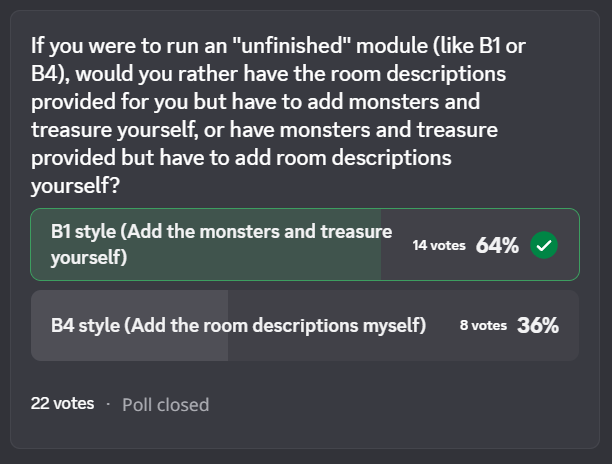
My knee jerk response was to choose 1, but as I thought about it more, I found it varied based on the system I was running. If I was running D&D, I'd prefer 1, but if I was running something else like Mothership, then I'd prefer option 2.
This led me to wonder how other folks prep their games. Prep is such a big idea that goes into playing RPGs, but it's kind of an ambiguous thing. What goes into prep? How much prep is needed? Where do I start with prep? It's obvious how contextual it is based on the person, system, and content being run that there's no right answer. The most important thing prep provides is this:
Prep builds confidence which builds agency in deviating from the written content.
Roll to Doubt captures this well by saying, "Prep is the material I need to comfortable improvise during pay as a reaction to player action and to conduct what is the shared goal for the session." I would agree with this as to the goal of prep, but it doesn't answer what it is. I'm adding to the prep blogwagon an entire year late with this post which is great as I have a bunch of material to draw on. Shoutout to elmcat for adding the search engine feature on the webring just as I began writing this. Anyway, the premise of the blogwagon was to share how each blogger prepped.
Prepping is like an Onion...
I first thought about prep as tiered rings where each ring sat in silo based on what type of prep it was. The boundary between each is fairly thin, and overlap is expected. The outermost layer of prep is related to time. It's campaign versus session, moving calendar days forward or seasons. The next layer relates to travel. How is the party moving through the world? This will determine the types of prep being done. Arguably, this layer could be skipped, pending your set up. If you're generating encounters and hex stocking during a session, then this layer doesn't exist in the same way.
So we could keep going, and it would end up looking something like this:
- Time
- World
- Region
- Player Locale
- Encounters
- Turns
Great, but there's a lot of interplay between each of these layers, and this model doesn't showcase that super well. When I started examining my own style, I found I was hopping between layers depending on the type of session, my attitude for the day, etc. I quickly realized this way of framing prep wasn't going to suffice, so I turned to my own experiences and began analyzing that.
Combing through the Data
Fortuitously, I recently finished running a mini campaign of Cloud Empress. It ran for 12 sessions, often meeting weekly on Mondays. Thankfully, I kept decent GM notes on each session and was able to use those combined with Session Recaps from players to create my dataset. I wanted to use this data to analyze what I prepped versus improvised and how much provided module content I used. I hoped with this provided insight into (1) how I ran CE each session and (2) what type of content I prepped. With all my session notes, I tagged each entry of notes as one of the following:
- Improvised: Created on the spot with no planning/based on the context of the moment in game
- Prepped: Created in advance before session start
- System: Reviewed in advanced and utilized at the table as written from books/content used
There was probably a better approach than this, but this is the data I have. My spreadsheet ended up taking this format:
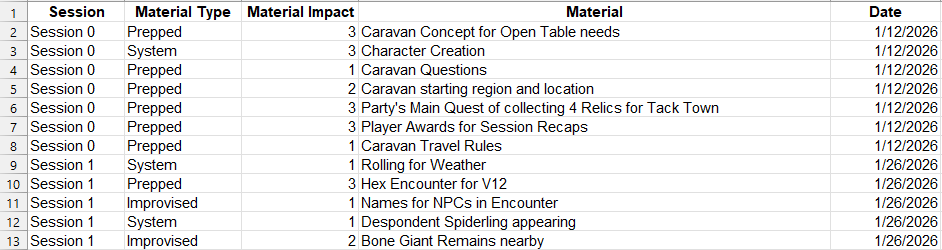
The Material column isn't quite 1:1 from my session notes but damn near. Remember, we're doing this to get a vibe check on prep. Material Impact is to provide a weight to each type of prep and its overall impact on the campaign, because even though I may have improvised a character's name, how much impact did that really have on the campaign? It's hard to say and again it's subjective as hell.
I'm very curious to track this data again with a different system. Unfortunately, my knowledge of the project will bring bias into the results but hopefully not too much. On the other hand, I can better track the data for the types of analysis I want to do with it. Anyway, I wanted to create a really cool Nightingale/Coxcomb chart, but I got too frustrated with Tableau and opted for the more classic bar chart.
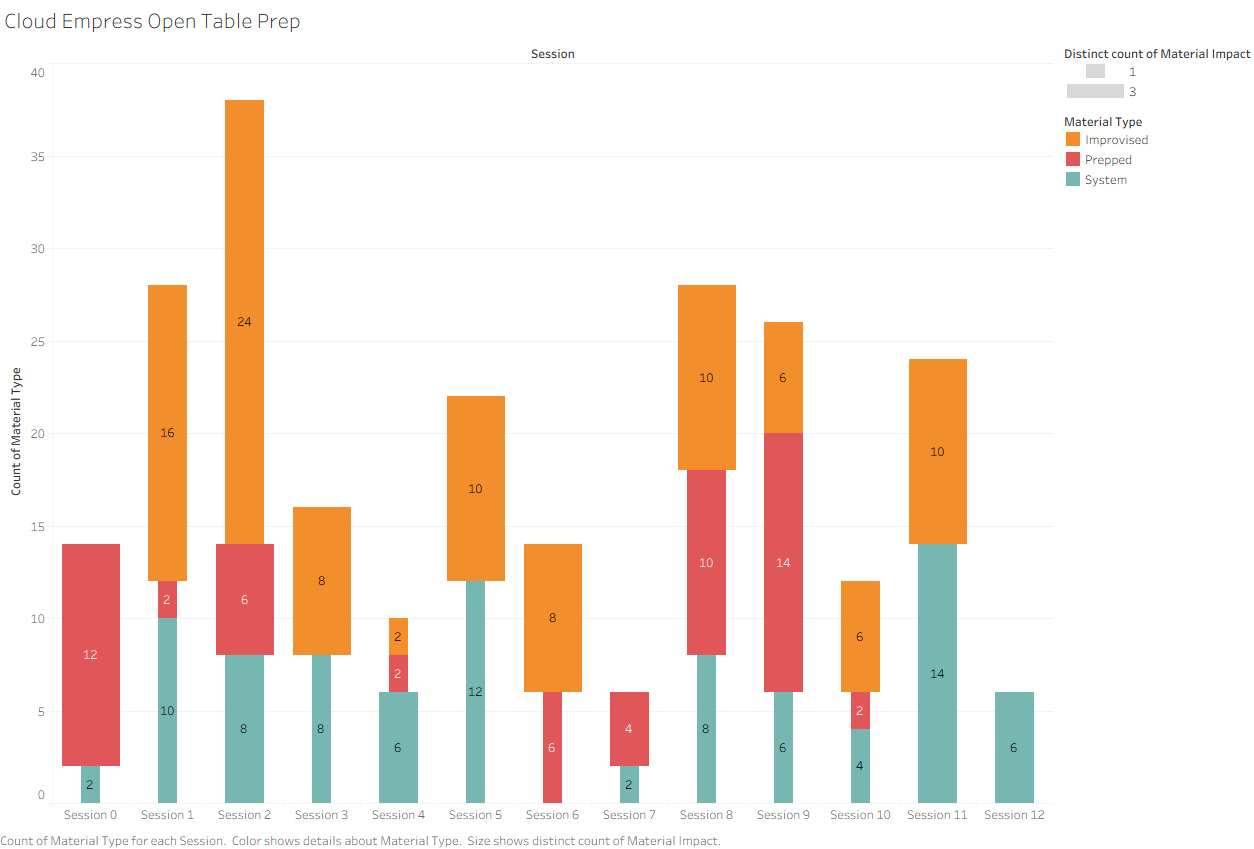
There's A LOT happening here. First, the count of each material type corresponds to a row in the spreadsheet. This count is broken up by Session # and then further divided by Material Type. The Material Impact is the width of each part of the column on the chart, so we can get a sense of whether the improv, prep, or system had a bigger impact on what the party chose to do. I think there's a pretty health mix throughout the campaign on which pieces had the biggest impact. I think the creation of a caravan and giving an overall quest to the party clearly had a big impact as it dictated what the party planned to do and how they traveled throughout the Hereafter.
Maybe I overweighted improv, but I felt from re-reading the session recaps, the moments of improv were the pieces of the game my players latched onto the most. While it didn't dominant every session, it was prevalent in at least half of the sessions as the dominating type of material. When improv wasn't at the forefront, it was prep which, for me, is a mix of what's provided in the system and my own interpretation/additional input. For example, Session #9 where prep and improv are evenly matched with prep winning out was when the party got lost. I was curious how the party would react and what would happen. I think each time the party moves from one hex to another, prep increments and improv increments at half the speed from the fact that the hex encounter is provided but how it resolves or what the party does in response is not.
The foundation of the entire campaign is consistently supported by the system which makes sense. Here, I think the data validates the role of the rules and the system in general. It provides enough material to start but then leaves ambiguity for the table to create their own canon. For example, funeral rites, greetings, and other cultural norms were set by the party and GM, not the books.
Do you see anything interesting in the chart?
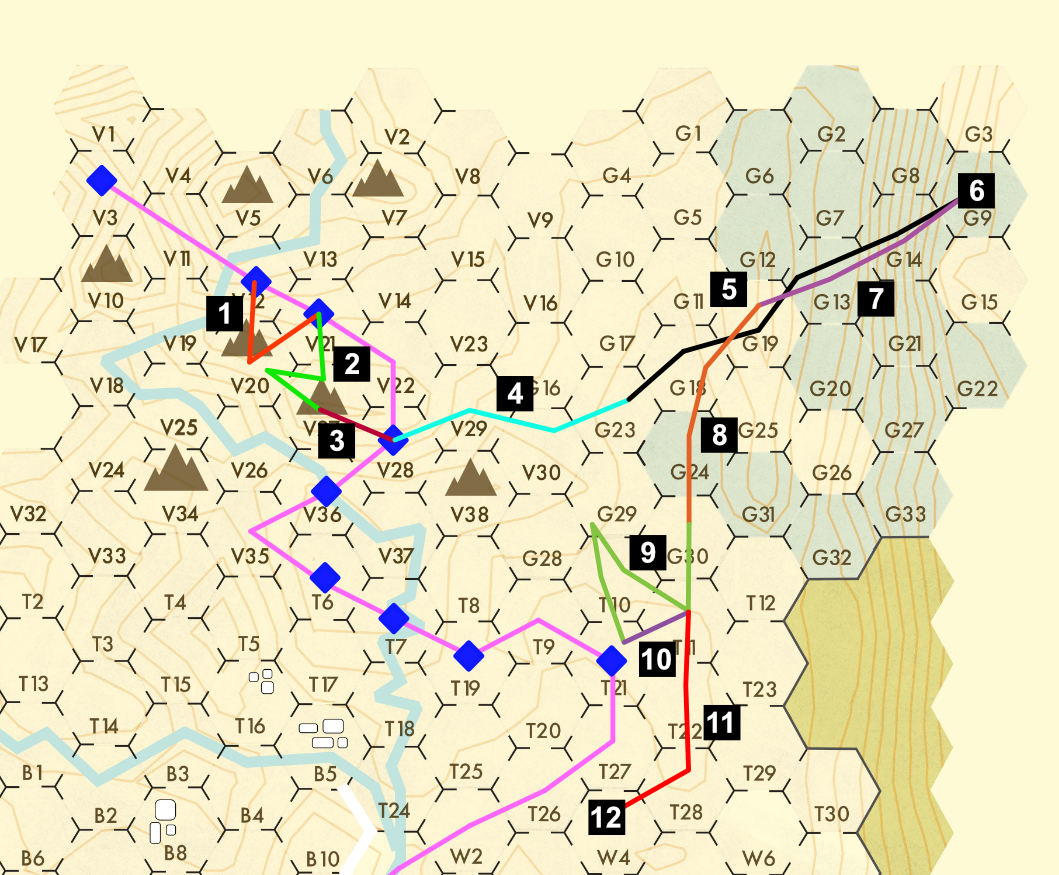 Note: The pink line with blue diamonds was the party's caravan that traveled separately with its own camping rules and encounters.
Some other interesting things on the bar chart. There's only 2 sessions without improv at all (#7 and #12), meaning it was absent for 16% of the mini campaign. Meanwhile, prep is missing from 4 sessions, a whopping 33% of the mini campaign. Even with rules to lean on, I'm more inclined to improve than prep something around it.
It makes sense that the final session (was not meant to be) ended with all System material, because the group was in the middle of a dungeon of sorts (Eastern Feeding Ground). Ideally, we had hoped to plan for another session, but life made other plans.
Overall, this was a really fun experiment to dig more into how and what I prep as a GM, and I'm excited to iterate on it with my next mini campaign. As a GM, have you done a similar breakdown? What did it look like?