Designing Location Blocks
I was looking to expand my Blogosphere setting, and I wanted to write-up locations for them. This led me to considering how and what would be included in each location. I wanted and needed a good schema for them. Rather than do a description in pure prose, I want something akin to a stat block or even the lore blocks which have been inspiring fun stuff. My goal is to take the lore block concept and apply it to only locations as the examples I’ve seen so far primarily apply to NPCs and monsters.
Unearthed…something, something
Surely, I was not the first to consider this idea, and I wasn't. I discovered Unearthed Arcana: Into the Wild, material that was released in 2018. It breaks Wilderness Exploration down into 3 phases:
- Choose Destination
- Choose Activities
- Resolve activities and travel
- Camp
While this material did not have Location Blocks, it put the idea of them out there with a sample region, using the new wilderness exploration rules. It inspired people to create their own version of Location Blocks albeit tied to the 5e system, which is great if that’s what you’re using, but I’m seeking system neutral schemas for the Blogosphere. Some of those different interpretations of the Location Block were mainly for homebrew or other campaigns. The three examples I found had the following overlap:
- Size
- Random encounters
- Traits
- Tags
- Difficulty
These 4 attributes have become quite standardized with perhaps Difficulty being dropped or augmented into something else. Random Encounters were tables of possible events for the party. Traits and Tags were used to describe the space in both the location’s resources and physical state. The differences are also striking:
- Peril
- Location Attributes
Peril was a single stat for all Locations that was modified based on the party’s behavior in the area. The interesting thing is it was always added to the result of a random encounter. I really like this as it pairs super well into my Terrain Affinity tool. The more players explore a space, the more it responds. These are active spaces that shift.
One of the homebrew versions has attributes for a location (Intensity, Mastery, Size, Energy, Exposure, and Hostility). This version feels more like a character sheet and while interesting would be less usable for me and my style.
The specific example from Gillgamesh’s Not So Epic Takes’s blog is the breakdown of attributes that don’t have many checks involved but accurately capture the physical and social context of the area. The attributes were Travel, Sustenance, Threats, History, and Mindset. It’s like the other example but without giving each attribute a number. Instead, some required a DC check (Sustenance as tied to Survival because again 5e) but other than that, it was all atmosphere building.
It all gave me a great starting point for creating my own Location Block schema for the Blogosphere.
Districts, Hexes, and so forth
As I looked through these examples, I realized they seemed familiar to some of the books I own. Some ttrpgs do have Location Blocks, but they aren’t called that.
Blades in the Dark
Blades breaks the city of Duskvol into Districts. At the back of the Blades book, each district gets a spread, listing the following:
- Landmarks: A handful of locations that matter to factions as factions play a large role in the system
- Details: A brief description of the Scene, Streets, and Buildings in the District
- Notables: Important NPCs, their faction ties, and what they’re doing.
- Traits: Each district has 4 traits (Wealth, Security & Safety, Criminal Influence, and Occult Influence) where each trait has 1 of 4 pips filled to give a rough idea of the presence within the district.
- Unique Ability: Each District in Blades holds a mechanical effect which adds flavor and resource management to an area.
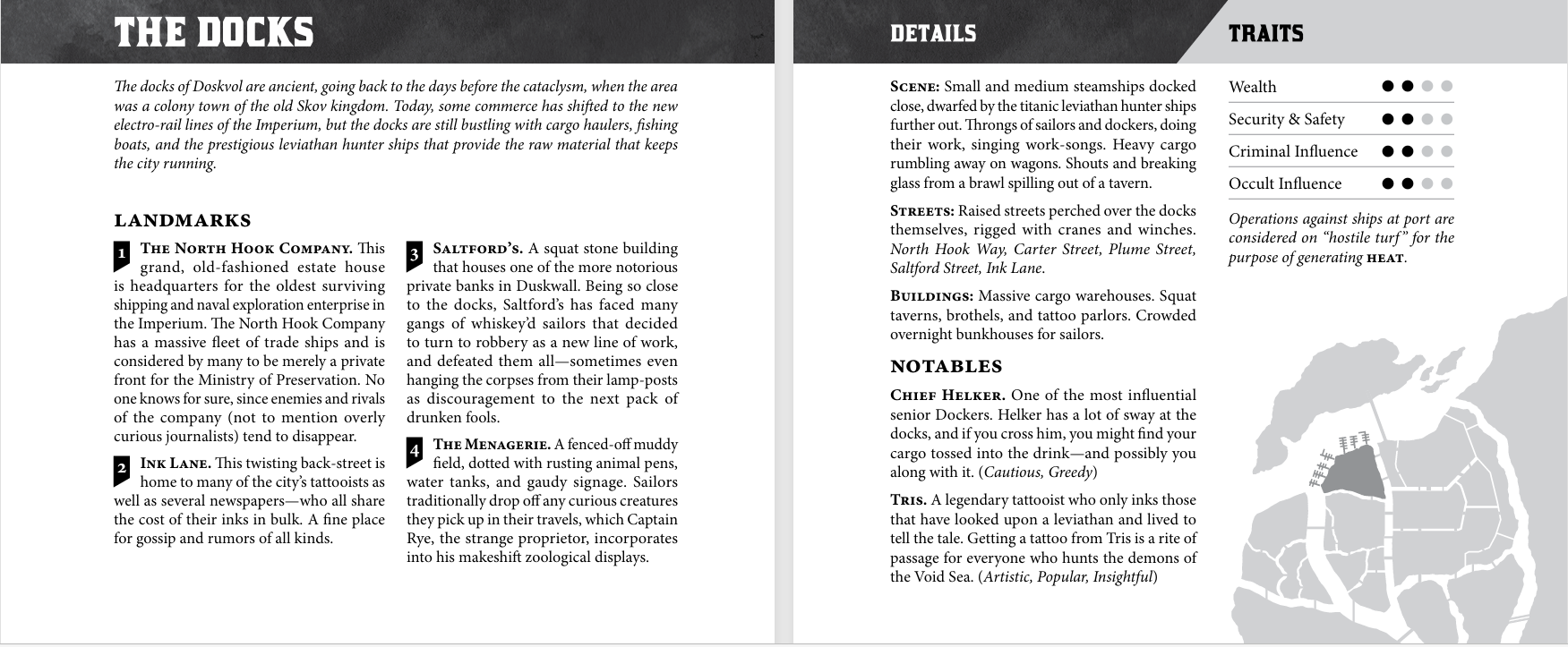
What I like about the Blades version are the Landmarks alongside the Details. These two are necessary to use the space in any way. The Notables are nice if your party is engaged with any of those factions or wants to be. They feel more like Hooks to me than anything else. Traits could be derived from reading the Landmarks and Details section though it’s a nice quick reference. However, there is zero indicator for what a 1 pip in Wealth versus 3 means for the District without its direct relation to other Districts.
Dolmenwood
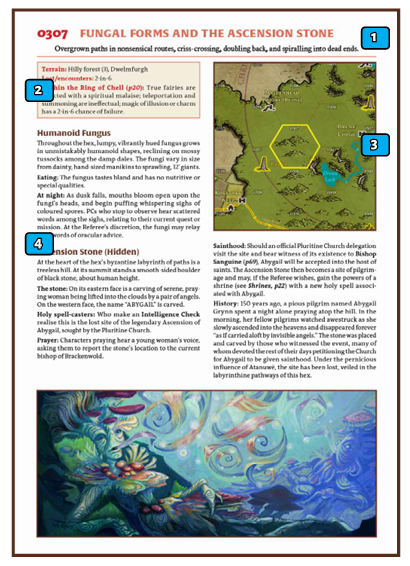
Dolmenwood also uses Location Blocks on a hex-based level. We oftentimes call these Keyed Hexes. In Dolmenwood, the structure is formal and a little daunting at first. Thankfully, the book is designed so well that it onboards the reader with how to navigate it. The key components of a hex in Dolmenwood are the following:
- Header: Hex Number, Name, Flavor Text
- Geographical Info: Terrain, Lost/Encounters, Foraging, 1 Notable Location to engage with
- Local Area Map: This tells you that you can click a neighboring Hex in the hyperlinked PDF. It’s incredible.*
- Features: Hidden, Non-Hidden, Map
*In fact, Dolmenwood may be the best hyperlinked PDF I’ve ever used.
Neverland
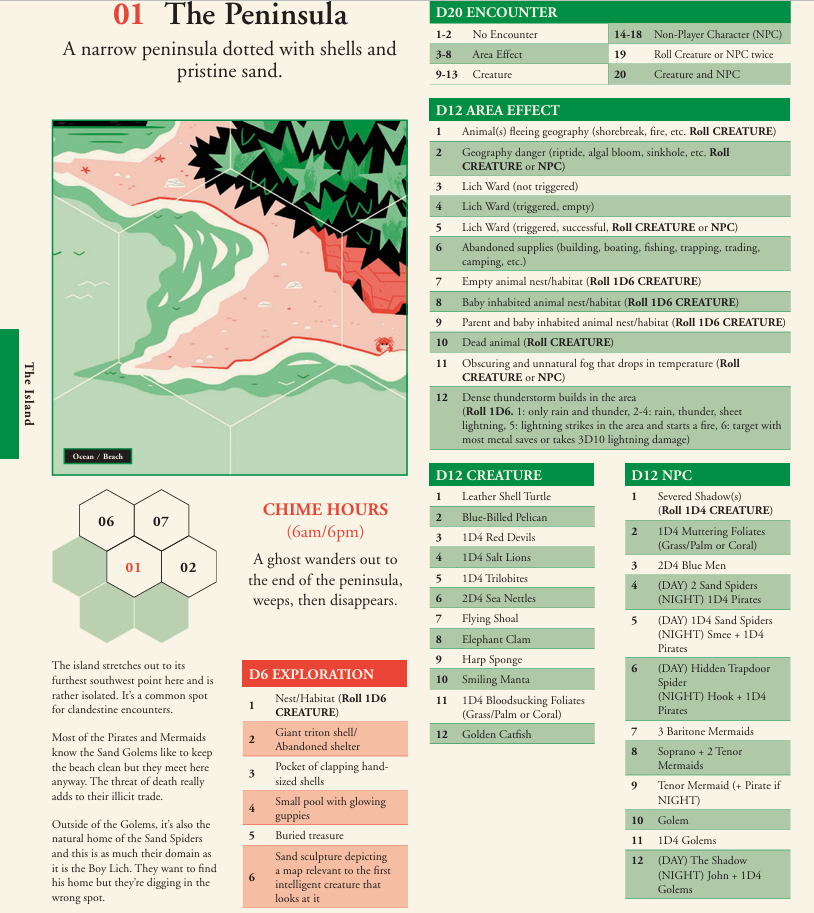
Like Dolmenwood, Neverland provides a page of each Hex within the map. Rather than concrete locations and specific NPCs, Neverland supplies the referee with a series of Tables (Encounter, Area Effect, Creature, and NPC). A specific Exploration table helps reveal the hidden features of a hex. When I ran Neverland, I struggled to utilize the tables thoroughly as I had not learned all the unique setting components (bestiary, factions, etc.). Neverland hexes differ from Dolmenwood in the following:
- Exploration, Area Effect, and Creature Table
- Chime Hours: A Neverland specific trigger occurs, and there’s a different trigger for every hex.
BREAK!!
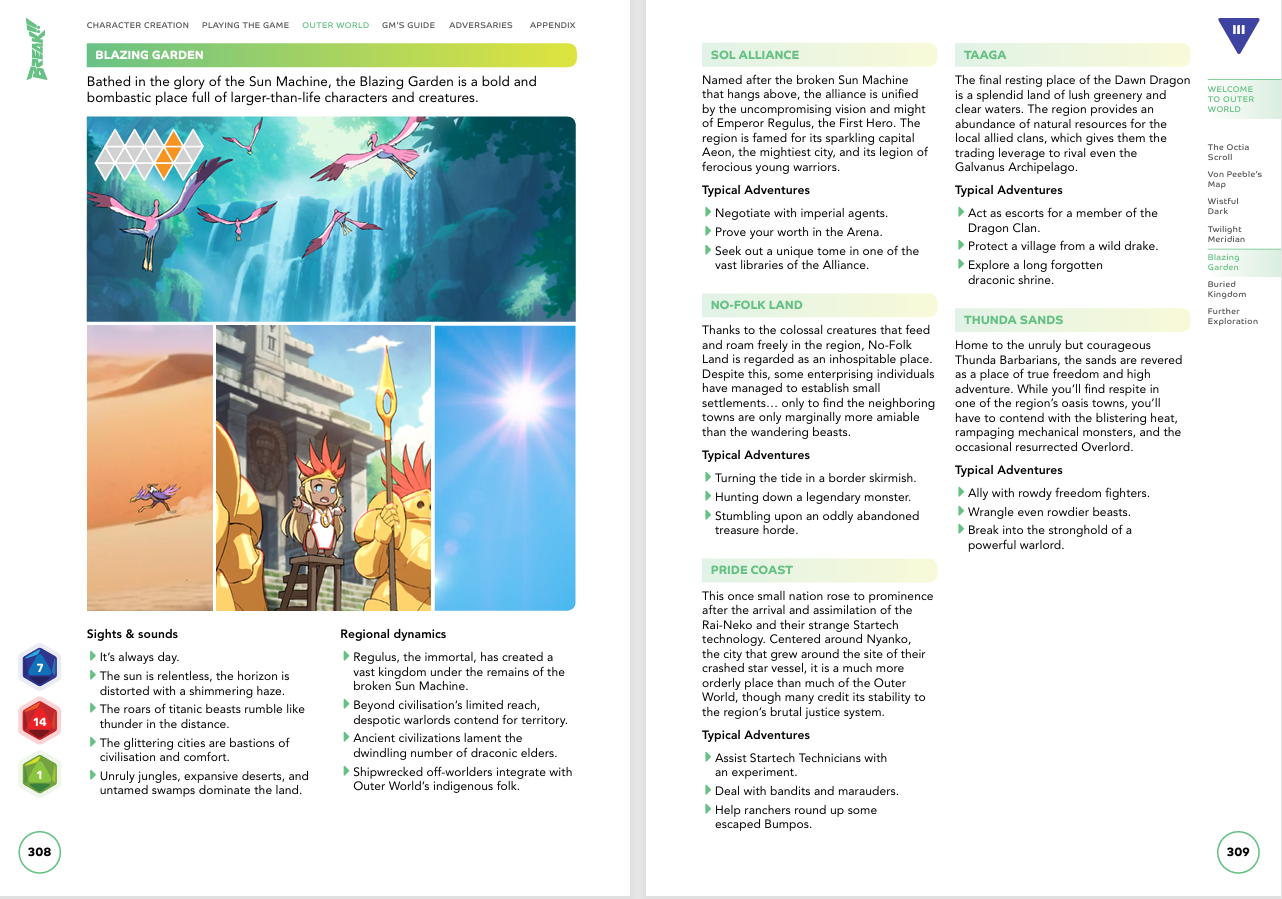
BREAK!! doesn’t provide hexes or points but rather gives a rough idea of possible adventures that can occur in a region. Each region is given a brief history of how it came to be as well as a list of notable areas within the region. Two short lists, Sights & Sounds and Regional Dynamics, provide descriptors of the region and social context.
These are all Location Blocks! The overlap between the Districts, Hexes and Points are:
- Landmarks
- Traits/Features
- Notable NPCs
- Optional: Unique Ability in the area
Locations within Crawls
As we can see in the examples, Location Blocks exist in every type of Crawl but are presented in different ways, depending on the goal of the location. I have found more examples of Location Blocks in things like the Stygian Library, Gods of the Forbidden North, and more. To include them all would be too much! The main point is, they have quite a bit of overlap and can even be argued to all be the same in their simplest form. I’m going to break down how different types of crawls present information and the types of information each provide. If I’m missing a crawl-type in this list, I challenge you to consider how its Location Block can match. I’ll consider the following types of crawls:
- Hex
- Point
- City
- Dungeon
- Depth
In a Hexcrawl, we call it Keying a Hex, while in a Pointcrawl it’s a Point of Interest. Depth similarly has points of interest, while a city crawl is more akin to a hex or point crawl. Dungeon crawls focus on rooms with each room being keyed. There’s a loose standard when it comes to keying dungeon rooms albeit it varies from system to system though the Designing Dungeons Course has provided a solid foundation for this kind of work.
Beyond presentation of the crawl, the information included in the location of a crawl is equally important. For hexcrawls, we focus on the terrain, what’s able to be foraged, etc. There’s a brief list of interesting places to explore in a hex. It could be argued that a sub-hex is a pointcrawl, but that’s the not point of this post! With pointcrawls, it’s a graph of connected points where each point can vary in size and distance is not limited in edge length. I haven’t played in a city or depth crawl yet. From my limited reading, a city crawl appears to have flexible levels of exploration that are quick and robust. Meanwhile, a depth crawl is a procedurally generated dungeon crawl.
All of these are sub-categories of the Location Block. While it could be argued that different information is needed, pending the type of crawl, I believe they can be stripped down to a uniform form, especially if the setting is designed to be system neutral.
Blogosphere Location Block
OK. After looking at some homebrew examples, I broke down a variety of crawl-types, and now I need to devise a schema for the Blogosphere setting. Do I need to decide the type of crawl before designing the Location Block? I say no. Do I need all mechanics figured out beforehand? It may help narrow down what info I want to include, but doing locations first can impact the type of unique mechanics, especially if the goal is to be system neutral.
Rather, I need the relevant bits of info I want to include in a space. I know I want to have as few numbers as possible, and I want the following information included for each Blogosphere Location:
- Name: Captures the essence of the location
- Identifier: A quick way to reference the place.
- Brief Description: A 1-2 sentence description of the space, often included in the header of a spot.
- Traits/Tags: I love the concept of Tags, but if you have specific descriptions for Tags that have mechanical application, it makes it more difficult to onboard players. Much like Blades does with NPCs, I love using 3 words that encapsulate the vibes/behavior purely from their definition alone. I’ve landed on Physical, Attitude, Action to describe an area.
- Unique Ability: With the Blogosphere, each location has a unique ability. I think Data Integrity will be an important mechanical feature that each location impacts.
- Notable Features: What’s in this space and why do I care about it. Every example, no matter the type of location, has this component. Does this need to be listed in the Location Block, or could sub–Location Blocks be included instead? Alternatively, using the same 3-Word descriptor layout for each of these could be the way to go. It depends on what information here is important.
What I may include:
- Rumors: These reward exploration and can be the cause of some fun gameplay at a table. I can’t decide if they are needed or something I’m so accustomed to seeing that I feel obligated to include them.
- Faction/Social Context: The Blogosphere is super self-referential and could benefit from a clear indication of who is around.
- Reaction: We use reaction rolls for NPCs and monsters, but I think it could be cool to use them for locations.
What I won’t include:
- Encounters: Though prevalent, I don’t believe encounters need to be included either. I would much rather provide regional encounter rolls alongside a main encounter table that applies to all locations within the Blogosphere. Encounter tables, like Tags, require prior game knowledge and for a custom setting, it can slowdown play when there’s too much to reference.
- Size: This is a piece of info not needed as it can be ascertained through other details.
- Level/Difficulty: These things will need to be scaled up or down, depending on the system used, so it is less of a concern for my project.
Example: Sand Sea
Name: Sand Sea
Identifier: A-01
Brief Description: A sea of sand which eats away at Bloggers slowly over time. Pockets of quicksand are littered along its rocky beach.
Traits: Barren. Eager. Consume.
Unique Ability: Resting here allows players to remove 1 piece of Corrupted Data.
Notable Features: Whirlpool of Discourse, Loquacious Lagoon, Quip ‘n Quake.
Reaction: Indifferent.Name: Whirlpool of Discourse
Identifier: A-01-01
Brief Description: A large whirlpool that wails unanswerable questions such as, “System doesn’t matter” and “All crawls are the same”. Each offhand comment tempts Bloggers to engage.
Traits: Destructive. Goading. Drown.
Unique Ability: Can be convinced its wrong and collapse in on its self.
Notable Features: None.
Reaction: Incendiary.
Name: Loquacious Lagoon
Identifier: A-01-02
Brief Description: Any who sit in the Lagoon engage in a never ending conversation with either themselves, others in the Lagoon, or the lagoon its self. One's body entirely relaxes save for their mouth.
Traits: Comfort. Longing. Charm.
Unique Ability: None.
Notable Features: A chat bot is embedded at the bottom of the lagoon.
Reaction: Inviting.
I think nesting the blocks makes sense if the form is concise and brief enough. Not sure if this is where I've settled on for the design of my location blocks in the Blogosphere, but this is an excellent start. Are the vibes and intention of the space adequately provided in the example? I believe if a regional encounter table was included for multiple areas, that would help as well. Beyond that, I'm not sure what else I would consider including.
What I haven't discussed much of is I spent a lot of time reading about exploration rules and what players and GMs were seeking when it came to exploration/discovery. Knowing what's wanted/needed at the table is just as important as considering what's already out there. I've included a small but certainly not comprehensive list of readin material I considered.
Where have you seen Location Blocks in the wild, and what do you think of them? Please share with me on BlueSky!
Additional Reading/References
Actually Awesome Adventurer's Atlas
Changing the Game: Location Stat Blocks
Deisgning Lore Blocks
OD&D and Outdoor Survival
Landmark, Hidden, Secret
Re-inventing the Wilderness: Part 1
The Grisly Eye, Location Blocks
Travel & Exploration Lite
Understanding the Exploration Pillar of D&D
Unearthed Arcana: Into the Wild
Unearthed Arcana: Into the Wild Breakdown