Improv, Play Culture, and Authority
As someone who GMs many games, I often think about improv and how that skill has grown with the number of systems and sessions I run. Not having this skill as a beginner GM made me very anxious to run games, but thankfully my friends encouraged and supported the habit. Now here we are.
Thinking more about the importance of improv at the table, I've never considered it from a player perspective. I started to wonder what constitutes player improv. One could argue that all player actions are improv and sure, you could, but I'm more interested in the taxonomy of player improv and how it functions. There are two broad categories, Scenes and World. The Scene category includes places that are tactical/narrative/zone-based, while the World concerns itself with regional/global concepts.
Though the party primarily interfaces at the Scene level, there are opportunities for moments where the World is shaped by the table collectively. Speaking of collective canon, I believe Mindstorm's World Anchor post has a lot of merit. I've been implementing World Anchors without realizing it, albeit with a different approach. Using a hexcrawl, I will take NPCs or encounters my players have visited and turn them into World Anchors, especially in a setting that does not function under the same norms that most players may have.
On the Macro
At this level, I'm primarily talking about the setting, the world etc. of the game being played. This can happen during play when table asks each other things like, "Would this person like to be buried? Is that common here?" I find questions like these cropping up all the time in the Cloud Empress table I'm running. One specifically was where a player invented the common greeting for Sliplanders, a group of people that live in the Valley region of the Lowland Wastes. At first, the player asked me, and I encouraged them to develop their own idea for it that would become canon.
Macro examples include the following:
- Traditions (Greetings, Holidays, etc.)
- Behaviors and beliefs a group have
- Landmarks
On the Micro
The Scene level is the most frequented by the party. It’s the dungeon room they’re in. It’s a narrative scene with a long-lost NPC. All those moments that are described and engaged upon sit on the Scene level. Players improvise in these spaces all the time. In a dungeon, it could be a tactical application to avoid a trap, but in a narrative scene, it could be persuading a traveler to help the party with a task.
Micro examples include the following:
- An object in a scene existing though wasn’t explicitly stated
- Narrative flavor a player creates or wants to bring to light
Play Culture
There's a direct relationship between play culture and the level of improv involved at a table. Depending on the system, this can be encouraged and perhaps may even drive players to certain systems over others. A certain level of trust and expectation is necessary for improv to be welcome and managed. Some players, often new, might state something that is unequivocally untrue and/or impossible without taking into consideration what the GM has shared. Setting those expectations at a Session 0 would make it clear to players what they can and cannot change in a world/scene.
System Encouragement
Some systems either specifically tell the GM or build it into their mechanics to have players answer worldbuilding questions, use resources to change the world in their own way, etc. This system level encouragement fosters the Play Culture while setting those expectations for the table. It offloads the authority the GM might otherwise have been issuing about a space. Authority in this sense being a declarative and unchanging stance on an idea within the fiction.
Dreamland
The playtest I participated in for Dreamland has insane amounts of improv. Players cast spells with a word bank, and the more words used the more powerful the spell. No dice, no buts – can you spin a tale in the dream world that fits? I’m extremely excited about its release.
Blades in the Dark
Many mechanics in BitD a back-and-forth between players where player agency takes the stage and decides what happens. This is most prominent with its flashback system where a player can, at a cost, recount something they did previously that helps them in the current situation. It falls directly into the Scene category of improv.
Slugblaster
Similarly to BitD, Slugblaster has a cool mechanic called Kicks (read Position from BitD) which increases the impact of a roll. The few times I’ve run the system; the Kicks have been the highlights for players where they describe the cool trick they pull off and how it helps their group get ahead in a situation. Maybe the conclusion here is FitD games encourage player improv!
Brindlewood Bay
In this game, the table actively decides who committed the crime and how, making it replayable and chaotic but in a sitcom way that’s fun and light.
Wanderhome
In the session at GenCon of Wanderhome I played, the table intentionally built off each other’s contributions in a way that was beautiful, respectful, and fun. In character creation, you shape relationships with other players but also actively shape the world you’re spending time in together.
Improv, Play Culture, and Authority
As I write this, I’m discovering there’s an important relationship between improv, play culture, and authority. All three of them shape table expectations and the actions available to both GMs and players. I’ve cobbled together a very loose ternary graph on how I think these relate to each other. This is by no means definitive and is perhaps different from GM to GM, regardless of the rules stated by the system. Rather, it’s governed by how people play them, to some extent.
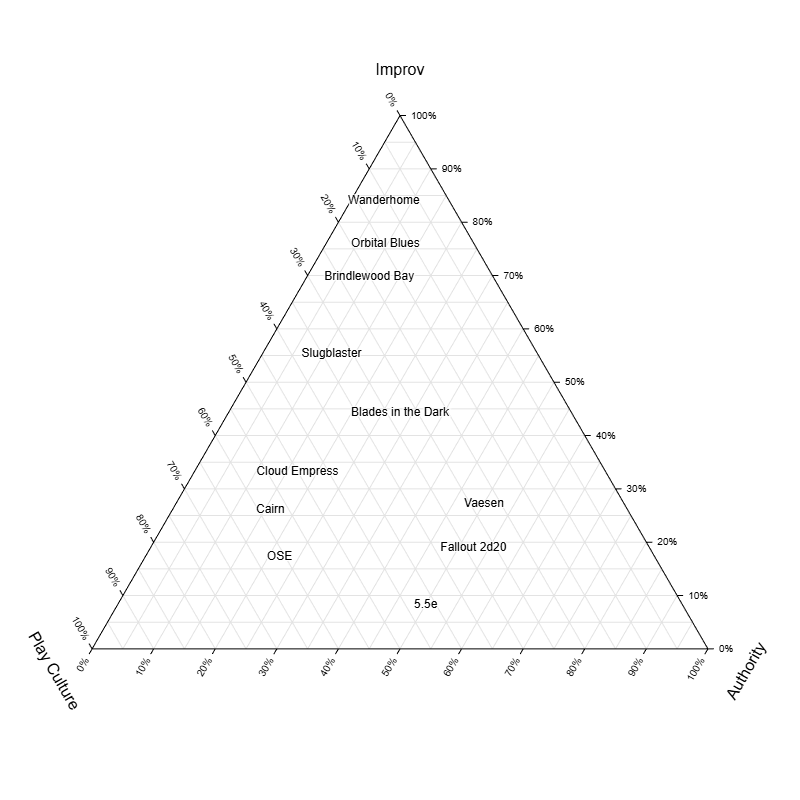
Why do we gravitate to some games over others? I wonder if the bias of GM expectations limits our ability to enjoy other systems. This goes in the opposite direction for GMs too. What player expectations are we putting out there and why? The play culture that brought us here might not be the one we want! What makes a system have a strong play culture? What place does authority have at the table? Still mulling over these things, but this is a good start.
Let me know the kinds of games you like to play over on BlueSky (@Bakenshake) and why!