Epistle Maps, An Exquisite Hamlet
I've been writing some non-fiction pieces and considering writng them in an epistolary fashion. I was noodlin' on how this could be applied to ttrpgs as all bloggers are wont to do, and I've come up with Epistle Maps: An Exquisite Hamlet. This combines the Exquisite Corpse process to create a map. Rather than roll for a prompt or pick one at random, players can only draw from the information they're provided through a letter that's written and handed to them by another player.
I've run a handful of playtests now, both in-person and online, and am gathering all my thoughts to push me to make this a real thing! My next steps are to continue playtesting and maybe playtest at conventions before moving into a final write-up? WOO!
The game is played over a series of Write/Draw phases. All phases are the following, and play often takesn ~2 hours with 3 rounds of Write/Draw.
Game Phases
- Set Up
- Write
- Draw
- Share
Gameplay Loop
- Set Up
- Decide as a group the size and vibe of the space you're in (modern? sci-fi? city? rural community?)
- Create a Character
- Briefly answer questions provided
- Choose who you're writing to
- Draw 1 place that's important to your character
- Write
- Write a letter
- Pass the letter to your left (alternate between rounds)
- Draw
- Read the letter
- Choose something from the letter and draw it on the map
- Keep this letter
- Return to the Write Phase
- End
- Write/Draw happens for X rounds
- Name
- At the end of the game, name the place you've created together
- Create a short blurb, describing the place
Set Up
This phase involves 2 steps, map expectations and creating a spark table. The first is to ensure what people draw stays in line with each other, while the second has two goals. The first is a good jump start on how people are thinking about the space, and the second is it can be rolled on as a prompt for writing your letter.
With a map, two important components are the scale and tone of the map. I originally created tables for players to roll on as folks weren't super keen on deciding something for the entire table. Throughout all my playtests, I've chosen the scale of the map, while the table agreed on the genre/tone.
For my first playtest, I chose a sci-fi village as everyone at the table understood the scale and genre, and I wasn't sure how well it would scale up. Somehow I've only done sci-fi based settings so far!
Scale/Genres done so far:
- Science Fiction, Village
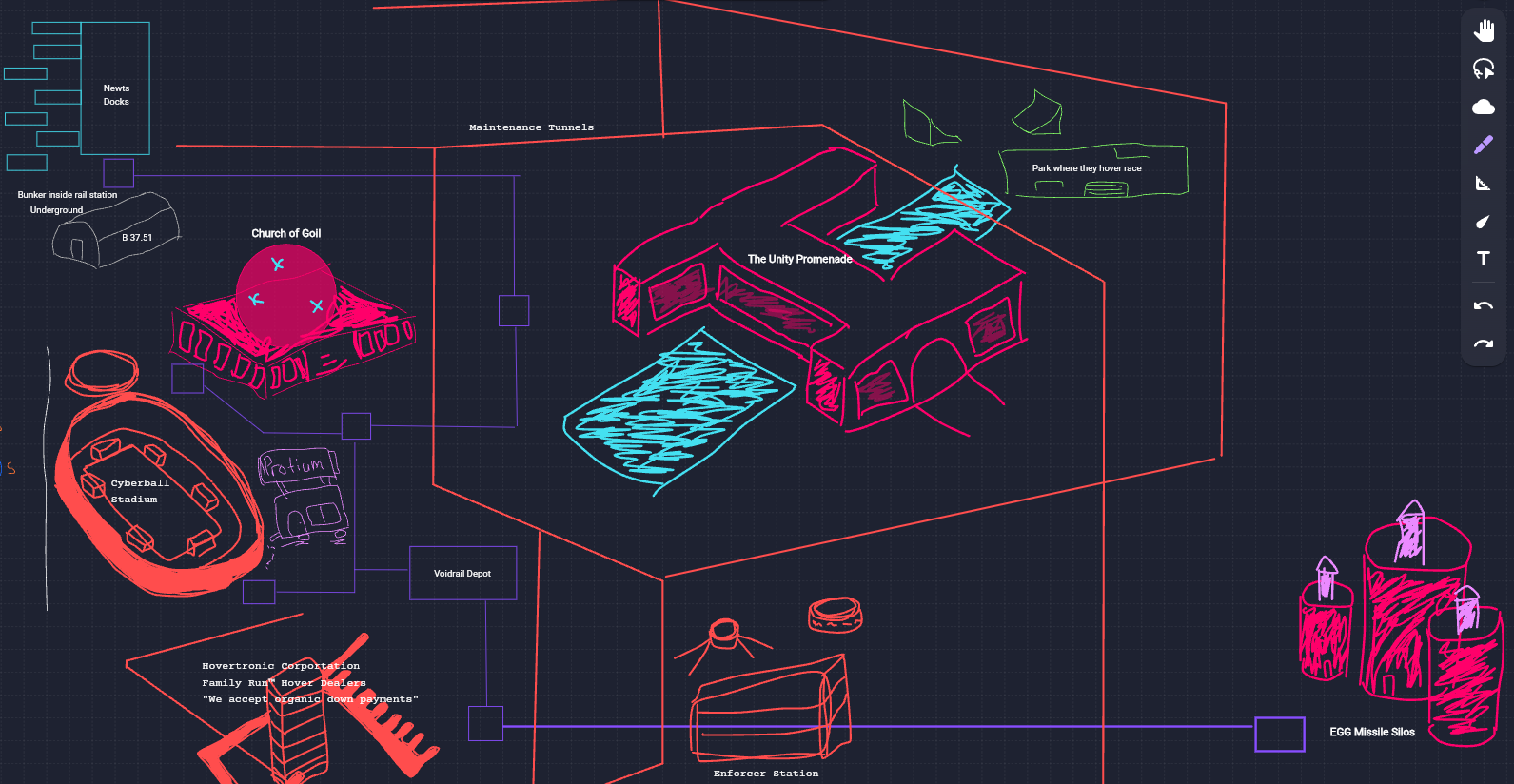
- Cyberpunk, City
- Space Station, Village
As a prompt generator, I thought creating a Spark Table, a rollable 2d20 table, would be perfect to give quick inspiration for what exists in the space. I've only used the spark table in one playtest so far, and it was a 2d10 table where each player contributed 1 word at a time. Some players that were more uncomfortable with letter writing rolled on the table and came up with some awesome stuff, so I think it's staying!
Character Creation
There is no character sheet but rather a short list of questions to get players thinking about who they are and why they are writing letters to begin with.
Questions to Answer
- What does your character do in this area?
- Who are they writing letters to and why?
- This does not have to be someone who is alive.
- What's their social status in this location?
- Are they well off? What's their awareness of the space in general?
- How long have they lived here?
- Visitors from far away? Lived here their whole life?
I found these questions were enough to give players a jumping off point. Soemthing really interesting is that players who have no ttrpg experience weren't overwhelmed by the questions and expectations. I don't know that I need a character sheet unless there's more mechanical involvement? Unsure, but it feels unnecessary at this point.
Design Note: I originally had players create relationships, but I discovered that there was not much inter-play with them. Instead, I have players draw 1 location on the map that is important to their character (home, where they work, favorite bar, etc.) I've only done this in 1 playtest, but it went super well, so I'm curious to continue using it.
Writing
The real meat of the game. I found that 7 minutes is the perfect amount of time to allow players to write a letter. I emphasize that letters take many forms and style and try to encourage them to write a minimum of 200 words.
Design Note: Some players thought they had to write to someone at the table, but this was not the case. I need to do a better job of explaining that the letter is to anyone they want.
Letters ranged from snippets of text messages, redacted documents, data logs, love letters to AI chat bots, etc. The range of letter styling provides a variety of creative output that players can pull from, and I think this makes the system really shine.
If something was referenced but left unnamed, the artist had final say on what the name of a space was. One letter mentioned a restaurant, and the artist named it, "Old Helga's Restaurant" which further permeated in other letters.
Another player concern came from naming something that has already been named or referenced, but I think this is part of the spirit of the game. Different groups have nicknames for the same location based on culture, societal groups, etc. so I think this is fine and even maybe good!
Here is what I tell players when it comes to letters:
Letters should encapsulate something important to the character. Ideally, each letter should be ~200-500 words long. You and your group can decide how long you want to write each round, but remember letters take time to travel from Point A to Point B and therefore should contain events that have happened over multiple days. The tone and style of writing is up to each player. Include drawings, poems, etc. A letter takes many forms and is not limited by words!
The other cool thing that happens with the letters is that once there are mapped locations, players start referencing them in future rounds which further builds the lore of the space. It's very cool!
Mapping
After writing, letters are passed either left or right (or in any fashion you want, really). I typically have players pass to the left in the first round. I only had to set a timer of 5 minutes for my in-person playtest, but that group were primarily artists/graphic designers with little to no ttrpg experience, so it was probably their favorite part.
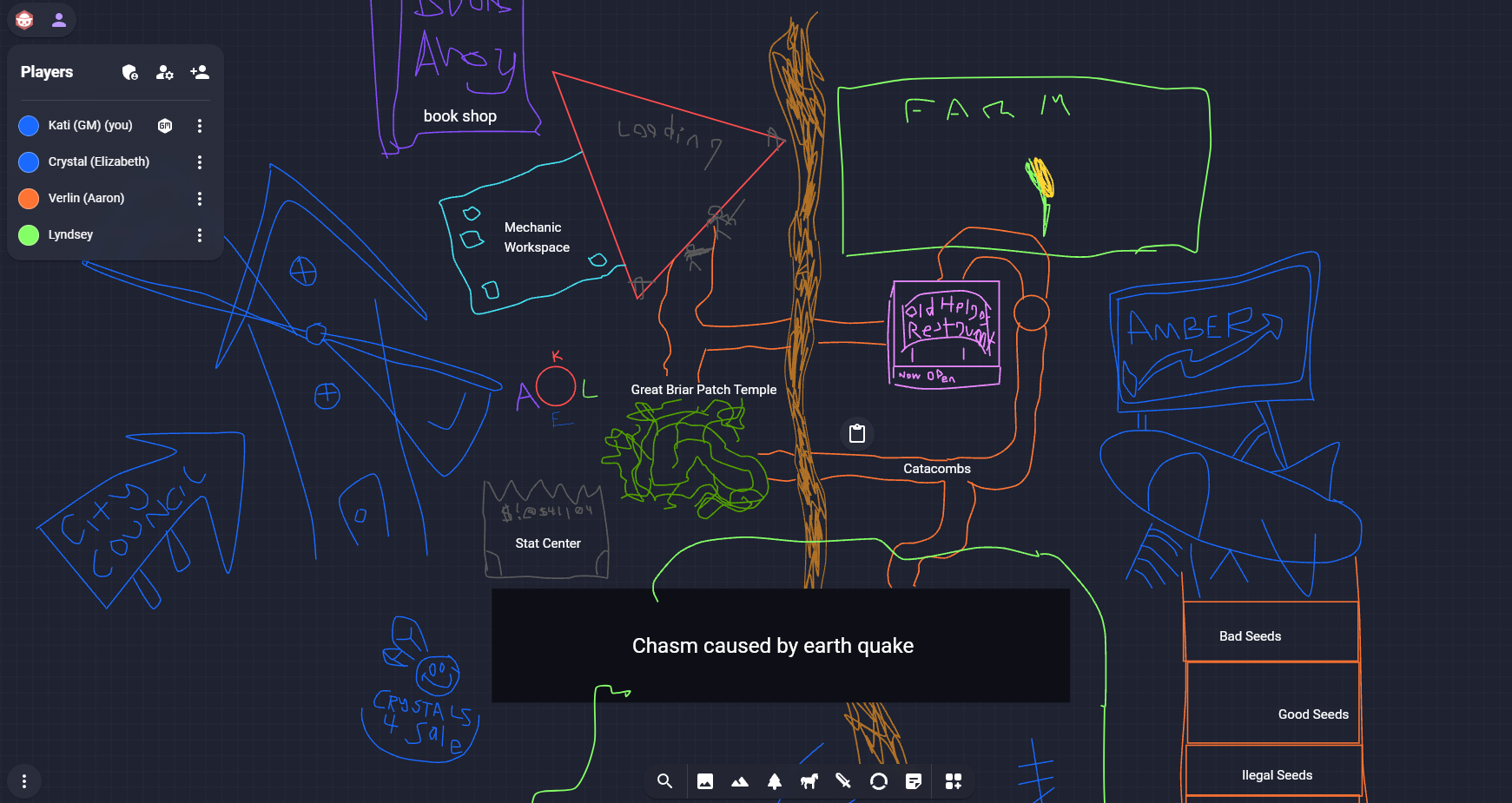
Most of the maps have been done in a mix of isometric and top-down, but it can be whatever the group decides to do. Players often ask if this a map to be used in the future, and it totally can be. This game, I think, would serve well mid-way through a campaign or even as a session 0 for a campaign. There's a bunch of utility in it, and I love that so so much.
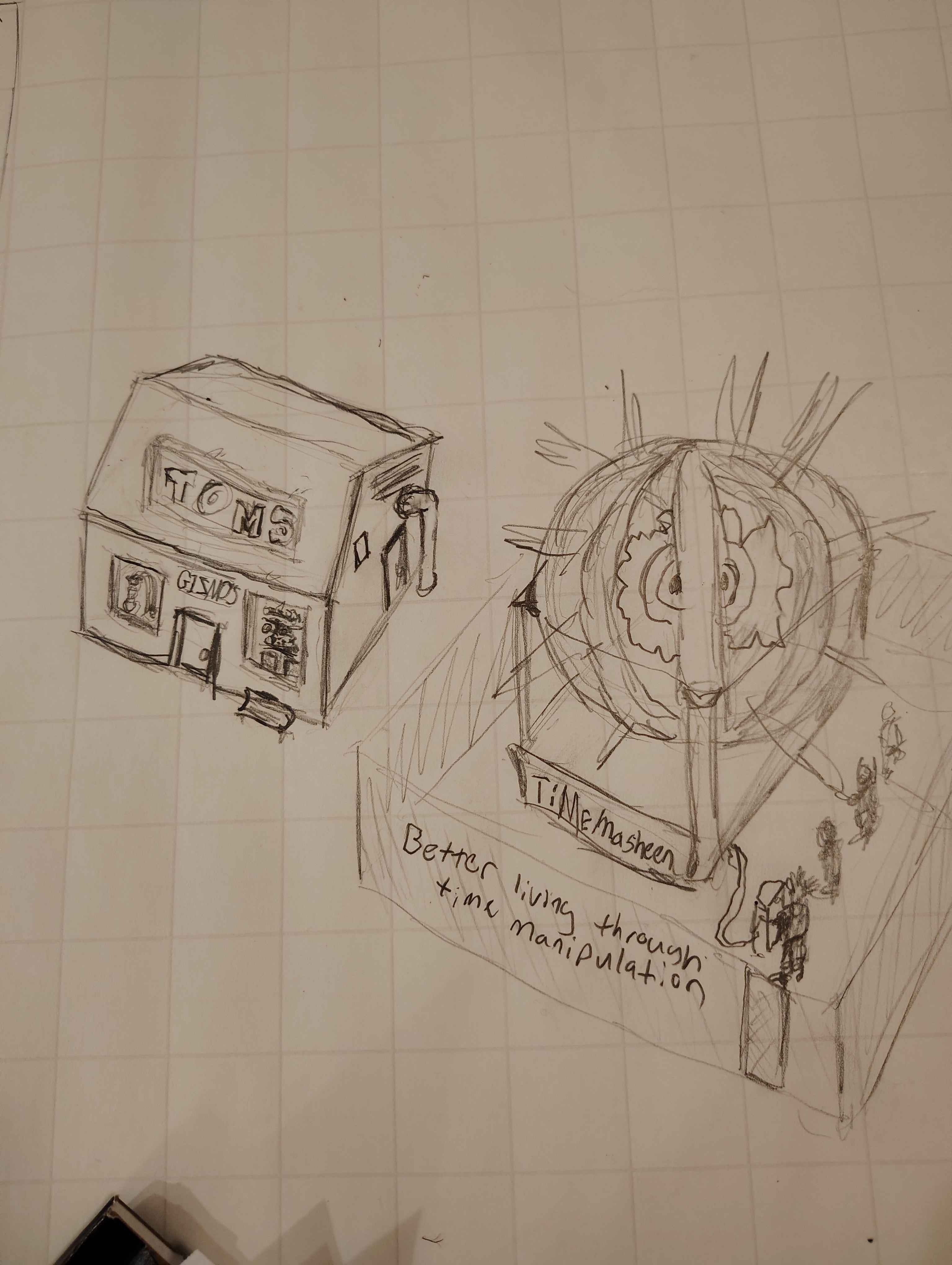
Players did share concern about their artistic ability and some fear about stepping on each others toes in regards to drawing something from their letter. This primarily happened when players didn't know each other, and I need to provide some language to make players more comfortable in building off of each others work.
Names Have Power
We all know names have power, and yet in all my playtests, my players refuse to name the city, village, etc. that they've created.
Design Note: Should the space be named? A sub-system for doing it?
This perplexed me, and my first solution was to have each player give a syllable of the place. I'm not sure it's needed, though, unless it's being used in an active campaign?
Design Thoughts
I want to include Secret letters where players put secret letters in the middle of the table. Perhaps if they roll on the spark table and one entry is Secret, giving players the opportunity to read/write a response could be used. Clearly still cooking on things.
Something else I want to provide in the final version of this are a variety of letter examples and styles of lettering. For example, I read about Junk Journaling and think it would make an awesome mode of play with letters.
Another piece that I need to examine is that players want a chance to share what they're drawing and why. It's cool to see it naturally progress but not having any context can sometimes feel bad for players. I'm not sure how to offset this as I normally just ask players about what they're drawing. I also think these natural secrets are part of the draw (pun intended) of the game, because a singular character won't know everything about a given space. Even though the map is collaborative, there's still moments of discovery with each round of Write/Draw.
Last idea I that's been percolating is that letters would be passed cumulatively, so by the third round, you would pass your entire stack of letters (3 in this example) to another player. I think this is too cumbersome for the current gameplay loop but is a fun chaos mode that could be done with more experienced players.
There's huge potential for this in asynchronous and play-by-post games that I haven't fully explored yet. Once I get a few more playtests in and a more robust ruleset written, I'll try a PBP format with a friend of mine. Fingers crossed it works well!
Thanks for reading! This is my first time developing a game and playtesting it. I'm excited about its potential and think it can create some wonderful spaces for players to explore. Let me know your thoughts on Discord or over on BlueSky (@Bakenshake).